
A few weeks ago I wrote about hitting Fable 5's guardrails repeatedly during a routine task, a simple claude.md file recording session that got flagged four or five times in a 30 minute window, with nothing unusual or sensitive in the conversation.
Since then I've kept testing Fable 5 across a wider range of projects, and a clearer pattern has started to show up.
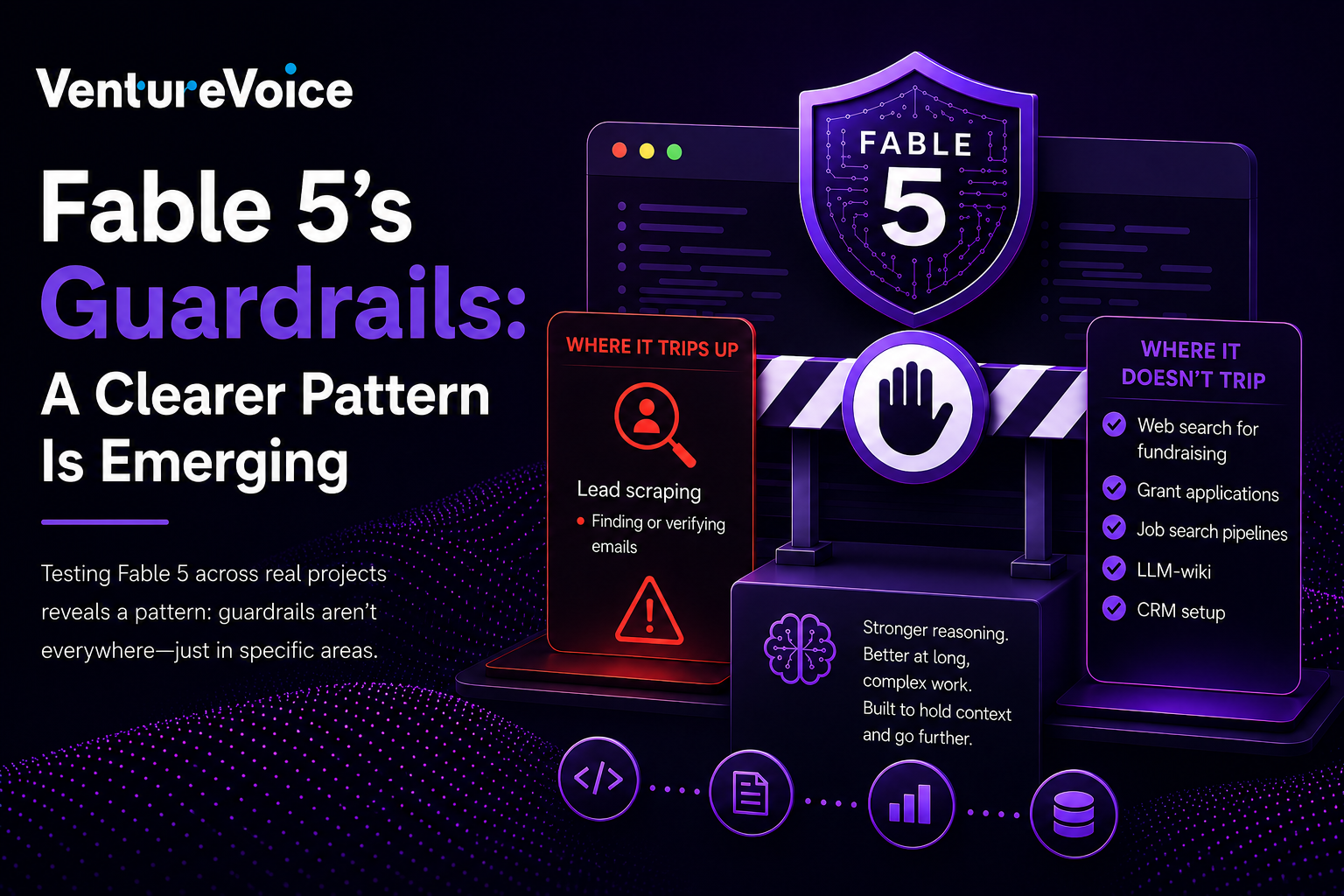
Where it trips up
Lead scraping. Every time I've used Fable 5 for lead scraping work, especially anything involving finding or verifying emails, it hits a guardrail.
My best guess is this comes down to privacy protections around personal contact information. Anthropic hasn't confirmed that specifically, so I'm treating it as an educated guess rather than a documented cause. But the pattern has been consistent enough across multiple attempts that it doesn't feel random.
Where it hasn't been an issue
Everything else I've thrown at it has run without a single flag:
→ Building web search capabilities for a fundraising project → Drafting grant applications → Job search pipelines → LLM-wiki work → Setting up a CRM
Different clients, different use cases, none of them tripped anything.
Beyond the guardrails, it's a genuinely capable model
Zooming out from the guardrail question for a second: Fable 5 is a strong model, and the benchmarks back that up.
Anthropic's own launch data shows Fable 5 leading nearly every category it tested, including software engineering, knowledge work, vision, and scientific research, with the lead over Opus growing the longer and more complex a task gets. On SWE-bench Pro, a demanding software engineering benchmark, Fable 5 scored 80.3%, well ahead of GPT-5.5's 58.6%. Analytics company Hex reported Fable 5 as the first model to break 90% on their benchmark for complex, long-running analytical work, a 10-point jump over Opus 4.8.
Third-party reports back this up. Stripe described Fable 5 completing a codebase-wide migration across a 50-million-line Ruby codebase in about a day, work that would otherwise have taken a full engineering team more than two months. Cursor's CEO called it the strongest model on their coding benchmark and said it opened up long-horizon problems that were previously out of reach for earlier models.
There are efficiency gains too, which partly offset the higher per-token price. One report noted Fable 5 reaching a physics research milestone in 36 hours using roughly a third of the reasoning tokens GPT-5.5 needed to get to a similar point in four days. In controlled testing on long-running tasks with persistent memory, Fable 5 also built on its own prior work noticeably better than Opus did under the same conditions.
None of that cancels out the guardrail friction I've hit on lead scraping work. But it's worth saying clearly: when Fable 5 isn't tripping a classifier, it's doing genuinely strong work, especially on longer, more complex jobs where Opus starts to show its limits.
What this tells me
The guardrails aren't blanket friction across all work. They seem tied to specific categories, particularly ones touching personal contact data. That's a more useful signal than "Fable 5 has too many guardrails," which is closer to where I landed after the first round of testing.
For now, my working approach is to keep lead scraping and lead-gen work on Opus, and lean into Fable 5 for the longer, more complex jobs where its extra capability actually shows up, coding-heavy builds, research-style work, anything that benefits from it holding context and reasoning over a longer stretch. It's still early, and one consultant's project mix isn't a full picture of how the guardrails behave. But it's a more specific pattern than I had a few weeks ago, and a better sense of where the model earns its keep.
If you've been testing Fable 5 and seeing something similar, or something completely different, I'd genuinely like to compare notes.
Want this running in your business?
Book a free 30-minute automation audit. We'll map your most automatable workflows. You keep the findings either way.
Book a free audit