
When Anthropic released Fable, I was eager to see how it performed outside of demos and benchmark charts.
Like many developers and AI builders, I don't judge a model by a single prompt. I judge it by whether it can survive a day of real work: building automations, writing code, debugging workflows, and iterating on ideas.
After spending the day using Fable extensively, one thing is already clear:
This isn't just another incremental model update.
But it's also not yet a straightforward replacement for Opus.
Fable Thinks Differently
The biggest thing I've noticed isn't necessarily that Fable is "smarter."
It's that it seems to reason more holistically.
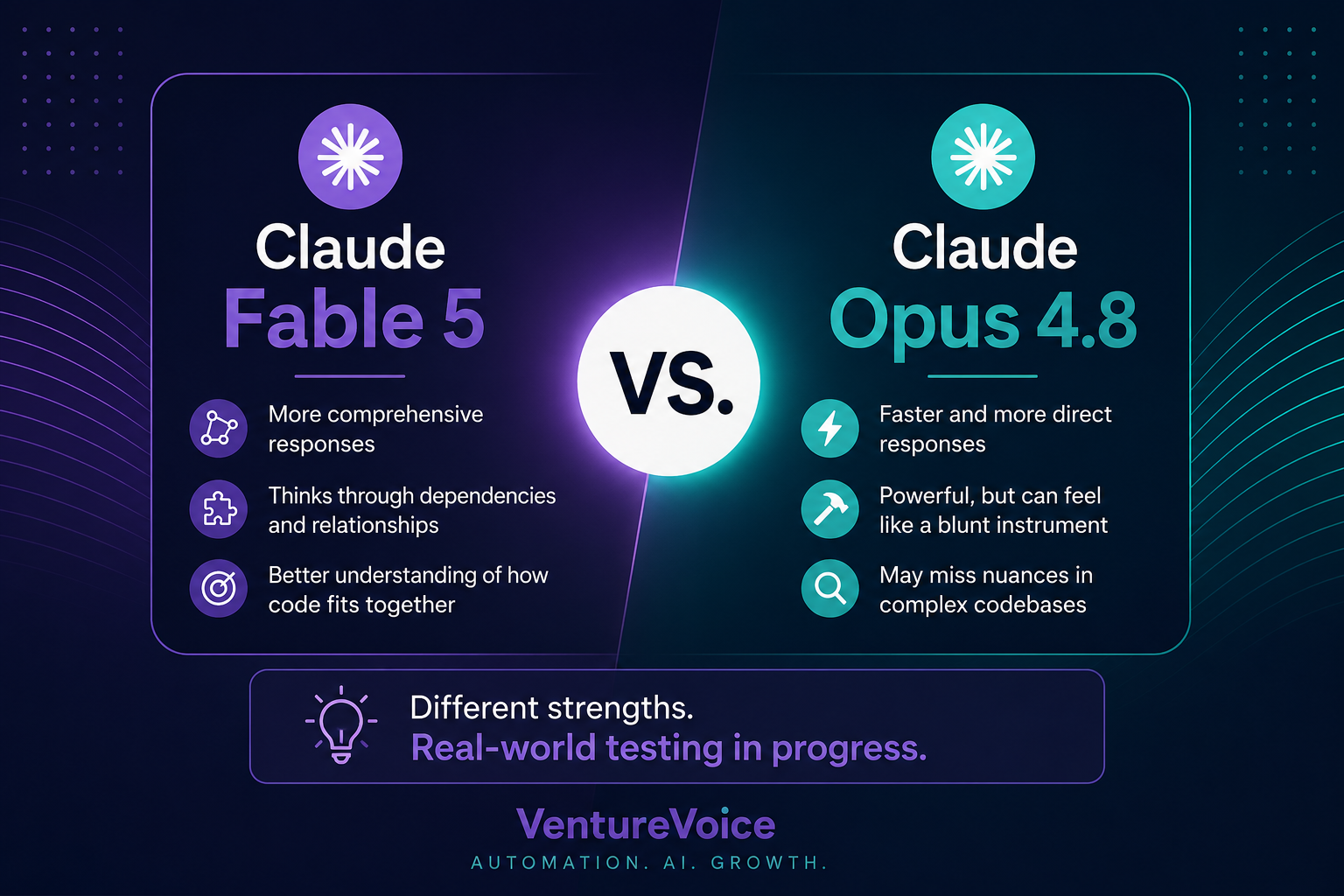
When working on larger coding projects, Fable appears to build a stronger mental model of how different pieces fit together. Instead of focusing on the immediate task, it spends more time considering dependencies, downstream effects, architectural decisions, and how changes propagate throughout a project.
That extra reasoning often leads to more comprehensive responses.
Sometimes they're longer than I expect, but they're also more complete.
It's less about producing code quickly and more about producing code that fits into the wider system.
Opus Still Has Strengths
Using Fable has also highlighted something interesting about Opus.
Opus often feels faster and more direct. You ask for something, and it gets to work immediately.
For many tasks, that's exactly what you want.
But when working across larger codebases or more complex workflows, I've found Opus can occasionally behave like a blunt instrument. It solves the problem you've asked about without always fully appreciating how that solution interacts with everything around it.
It isn't that the answers are wrong.
It's that they can sometimes miss the subtle relationships between components, abstractions, or existing architecture.
Those nuances matter when you're building systems that continue to evolve over time.
Where I'm Running Into Friction
Ironically, the biggest limitation I've encountered so far hasn't been Fable's capability.
It's been the guardrails.
Several times throughout the day I've found the model becoming more cautious than the task seemed to warrant, adding friction to workflows that should have been straightforward.
When you're deep in an iterative development session, those interruptions break momentum.
I completely understand why Anthropic continues investing heavily in safety. As these models become more capable, responsible deployment becomes increasingly important.
The challenge is balancing that responsibility with the needs of people using these models for legitimate engineering, automation, and creative work.
Right now, that balance still feels like it's being refined.
It's Too Early to Pick a Winner
After one day, I'm not ready to declare that Fable replaces Opus.
I'm also not ready to say the opposite.
The differences between the two models feel more nuanced than a simple "better" or "worse."
Fable seems more deliberate. It reasons through interconnected problems with impressive depth and often catches dependencies I might have expected to surface only later in development.
Opus remains incredibly capable, but its style feels more direct, sometimes at the expense of those broader architectural considerations.
That's an interesting trade-off, and one I want to explore further.
My Plan
I'm planning to use Fable as my primary model over the next several days to see whether these early impressions hold up across more projects.
First impressions are valuable, but they're rarely the whole story.
The real test isn't whether a model can solve one difficult problem.
It's whether you still want to use it after hundreds of prompts, dozens of coding sessions, and countless iterations on real client work.
That's where the differences between models become genuinely meaningful.
I'll share a follow-up once I've spent more time with it.
I'm curious to see whether these initial strengths continue to stand out or whether they're simply the result of approaching a new model with fresh eyes.
Want this running in your business?
Book a free 30-minute automation audit. We'll map your most automatable workflows. You keep the findings either way.
Book a free audit